
The government may be staring at a modest slippage in fiscal deficit for 2022-23 (FY23), with the Ministry of Finance seeking parliamentary approval for additional spending through a second and final tranche of supplementary demands for grants. On Monday, as the Budget session of Parliament resumed, Finance Minister Nirmala Sitharaman sought Parliament approval for additional gross spending of Rs 2.7 trillion in FY23 (which ends on March 31). While net cash outgo is pegged at Rs 1.48 trillion, the rest will be matched by savings or enhanced receipts, the finance ministry said.

Fitch Ratings has revised India's GDP growth estimate to 12.8 per cent for the fiscal year beginning April 1 from its previous estimate of 11 per cent, saying its recovery from the depths of the lockdown-induced recession has been swifter than expected. In its latest Global Economic Outlook (GEO), Fitch said revision is on the back of "a stronger carryover effect, a looser fiscal stance and better virus containment." "India's second half of 2020 rebound also took GDP back above its pre-pandemic level and we have revised up our 2021-2022 forecast to 12.8 per cent from 11.0 per cent," it said. "Nevertheless, we expect the level of Indian GDP to remain well below our pre-pandemic forecast trajectory."

'The RBI's MPC will maintain the current policy rates (6.50%) at the policy meeting, given ongoing inflationary pressures.'
The central government's fiscal deficit touched 67.8 per cent of the full-year target at the end of January due to higher expenses and lower revenue realisations, according to official data released on Tuesday. In actual terms, the fiscal deficit or gap between the expenditure and revenue collection during April-January period stood at Rs 11.9 lakh crore, as per the data from the Controller General of Accounts (CGA). The fiscal deficit in the comparable period of 2021-22 was 58.9 per cent of that year's Revised Estimate (RE) in the Budget.
India Ratings and Research on Friday revised down India's FY22 real GDP growth forecast to 10.1 per cent, from earlier projection of 10.4 per cent, citing the second wave of COVID-19 infections and slower pace of vaccination. At a time when large parts of the country are experiencing tremendous pressure on medical infrastructure, the agency said it expects the second wave to start subsiding by mid-May. Earlier this month, the Reserve Bank maintained its 10.5 per cent GDP growth estimate, but Governor Shaktikanta Das has flagged the rising cases as the biggest impediment to recovery.

International oil prices continue to be extremely volatile, falling on one day and rising thereafter, a top oil ministry official said explaining the reason behind no reduction in petrol and diesel prices despite softening in input cost, but could not say if the rates will be cut before Maharashtra elections. Global oil benchmark Brent crude futures fell below $70 per barrel last week -- the first time since December 2021 -- but gained thereafter. Brent was trading at $74.58 per barrel on Thursday while West Texas Intermediate advanced to trade at $71.71.

The government plans to borrow a record Rs 15.4 lakh crore from dated securities in FY24 to meet its expenditure requirement to prop up the economy.

The new numbers show India's economic growth rate averaged 6.7 per cent during the Congress-led United Progressive Alliance regime as compared to 7.3 per cent under the present government. Previous numbers had put the average growth rate during the 10-year UPA rule at 7.75 per cent.

'Retail investors, who had not seen such a massive correction in the SMID universe since COVID-19, are witnessing something like this for the first time. Panic profit booking may continue.'

Fitch Ratings on Tuesday raised India's growth forecast for the current fiscal to 7.2 per cent, from 7 per cent projected in March, saying elevated consumer confidence will drive spending, besides increased investments. In June update to its global economic outlook report, Fitch said it expects inflation to decline to 4.5 per cent by end of this year and RBI to cut policy interest rates by 25 basis points to 6.25 per cent.
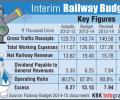
Anticipating healthier economic growth, the Railways has targeted a record Rs 1.6 lakh crore in revenue for the next financial year, while no increase has been proposed in passenger fares and freight rates.

India's industrial production output decelerated to 4.8 per cent year-on-year in July 2024, mainly due to poor performance of the manufacturing and mining sectors, as per official data released on Thursday. The factory output growth, measured in terms of the Index of Industrial Production (IIP), was revised to 4.7 per cent in June from provisional estimates of 4.2 per cent released last month. The IIP for July 2024 was 4.8 per cent, as per the data.

To meet the revised estimates for 2019-20, the central government will have to garner Rs 5.03 trillion in total revenues in March, which has seen the worst phase of the coronavirus pandemic so far and the resultant lockdown.

The government had set the direct tax collection target of Rs 3.70 lakh crore (Rs 3.7 trillion) in the budget for 2009-10, which was later revised upwards to Rs 3.87 lakh crore (Rs 3.87 trillion).

The agency had received Rs 946.51 crore to manage its affairs in the Budget Estimates for 2023-24, which was later increased to Rs 968.86 crore in the Revised Estimates.

The upper market capitalisation (mcap) threshold for midcap and smallcap stocks in the mutual fund (MF) industry's revised list of stocks, to be announced this month, is set to see the second-highest yearly rise in the past five years. The list was first announced in 2018, and it has been revised every six months since then. According to estimates released by Nuvama Alternative & Quantitative Research, the upper threshold for the midcap and smallcap universes could come in at Rs 66,700 crore and Rs 21,900 crore in the next list.

'We are in a position to start due diligence and private data room access shortly.'

IMF Chief Economist Gita Gopinath also said the pickup in global growth for 2020 remains highly uncertain as it relies on improved growth outcomes for stressed economies like Argentina, Iran, and Turkey and for under-performing emerging and developing economies such as Brazil, India, and Mexico.

After a gap of nearly two years, India's industrial production turned negative as it contracted by 0.1 per cent in August, mainly due to a decline in the mining and power generation sectors' output, in addition to an almost flat expansion in the manufacturing sector. According to the data released by the National Statistical Office (NSO), factory output growth based on the Index of Industrial Production (IIP) has also been revised downwards for July to 4.7 per cent from the earlier estimate of 4.8 per cent. "The IIP growth rate for the month of August 2024 is (-) 0.1 per cent, which was 4.7 per cent in the month of July 2024," NSO said in a release.

Bank credit growth is expected to moderate this financial year after a robust 16 per cent estimated for last financial year, driven by strong economic activity and retail credit demand. There are three reasons for this: a statistical high-base effect given the strong growth seen last financial year, revision in risk weights by the Reserve Bank of India (RBI), and relatively slower economic activity.
The eighth Budget of Finance Minister Nirmala Sitharaman continued to focus on 'GYAN' (Garib, Youth, Annadata, Nari) to maintain a consistent and coherent strategy initiated over the years in pursuing the government's vision for Viksit Bharat. The approach, characterised by incremental yet impactful steps, aims to create a compounding effect over time.

An Indian would have got Rs 40,141 during 2008-09, if the country's wealth was equally distributed among its citizens, according to the revised estimates of the national income.

The suspected undisclosed income in these cases could reach as much as Rs 15,000 crore.

India on Monday set aside over Rs 7,100 crore in its budget for 2021-22 as development assistance for countries in its neighbourhood as well as in Africa and Latin America, with Bhutan getting the maximum allocation of Rs 3,004 crore while Rs 100 crore will be given to Chabahar port project in Iran.

Be it poor, middle class, upper middle class or rich, every individual who is 70 years and above is eligible for getting Ayushman card and will receive free treatment up to Rs 5 lakh at any of the AB PMJAY empanelled hospitals once the expanded scheme gets launched.

'The private sector believes that some enablers in labour-intensive sectors like apparel, toys, tourism, and media retail, can unlock a lot of jobs.'

India's informal economy and service sector accounts for over three-fifths of its $1.8 trillion economy.
Shares of Mukesh Ambani-owned Reliance Industries Limited (RIL) rose nearly 1 per cent on Tuesday, hitting an intraday high of Rs 2,986.05 per share, after most brokerages reacted positively to the company's March quarter (Q4FY24) results. The bullish outlook stems from Reliance Jio's potential tariff hikes, given the competitive landscape, along with slow but steady improvement in the oil-to-chemical (O2C) vertical.

While presenting the Union Budget to Parliament earlier this month, Finance Minister Nirmalal Sitharaman had raised fiscal deficit target to 3.8 per cent of the GDP from 3.3 per cent pegged earlier for 2019-20 due to revenue shortage.

Finance Minister Nirmala Sitharaman on Thursday announced a Rs 11.11 lakh crore spending on infrastructure and vowed to continue reforms as she resisted resorting to populist measures in Modi government's last Budget before general elections, instead choosing to stay on the path of cutting deficit while bolstering measures for focus groups.

The government had budgeted revenue realisation for 2012-13 fiscal at Rs 10.38 lakh crore (Rs 10.38 trillion).

The situation raises concerns about whether the promised freebies will once again push the state into a revenue deficit.

'Personal income tax is growing by 27 per cent and most refunds have already been issued.'

Pre-Budget excercise next month should scrupulously avoid adventurism of all types and refrain from making excessively ambitious projections on revenue and expenditure numbers for 2023-24, suggests A K Bhattacharya.

Global firm Accenture's fourth quarter results prove that the worst is behind for the Indian information technology (IT) sector, said analysts on Friday (September 27). While the pace and the broadness of recovery is debatable, they said Accenture's results and revenue growth guidance for the next financial year (FY25) reduce downside risks for Indian IT companies.

The central government is likely to further consolidate its fiscal deficit by 50 basis points (bps) to 5.9 per cent in FY24 from 6.4 per cent in FY23, according to a recent report released by Goldman Sachs on Tuesday. In the current fiscal year, there is going to be an upside of 0.5 per cent on the receipts side due to higher nominal GDP growth, and higher tax buoyancy because of the formalisation, the report said. The upside to expenditure is mainly going to come from incremental subsidies (0.8 per cent of GDP), in both food and fertilizer, it said. The upcoming pre-election Budget will carry forward the trend of the increased capital expenditure seen in recent years.

The government has exhausted only 39 per cent of its fiscal deficit target in the first half of FY24.

Finance Minister Arun Jaitley more than halved the central government's financial support.

New estimates of India's gross domestic product (GDP) are "puzzling", Arvind Subramanian, chief economic adviser at the finance ministry, said on Friday.

'GenAI programmes may not be large in terms of value, but have triggered a lot of new opportunities among clients.'
